



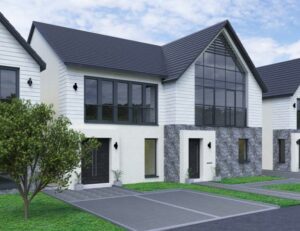
As the construction industry faces increasing pressure to deliver energy-efficient, sustainable, and cost-effective homes, Passive House design is gaining momentum as a blueprint for the future. This approach is not only about cutting carbon emissions but also about creating homes that are more comfortable, affordable to run, and resilient in the face of rising energy prices.
What is a Passive House?
Originally developed in Germany, the Passive House (or Passivhaus) standard focuses on ultra-low energy demand achieved through exceptional insulation, airtightness, high-performance windows, and mechanical ventilation with heat recovery.
The outcome is a building that uses up to 90% less energy for heating and cooling compared to traditional housing, while at the same time providing stable indoor temperatures and improved air quality throughout the year.
Benefits for Occupants
Occupants benefit from reduced energy bills, fewer draughts, and a healthier living environment—advantages that are increasingly important for households across all income levels.
Policy and Regulation
Governments across Europe and the UK are moving toward stricter energy performance standards, with net-zero targets making low-carbon housing a necessity rather than a choice.
The UK’s Future Homes Standard, due to be implemented from 2025 onwards, will require all new homes to produce significantly lower carbon emissions. Passive House principles align closely with these requirements, offering a ready-made framework for compliance.
This makes them increasingly relevant not only for private developers but also for local authorities and social housing providers seeking long-term solutions that protect both residents and investment value.
Challenges to Overcome
Of course, building to the Passive House standard does come with challenges. The upfront costs can be higher than traditional methods, mainly due to the use of specialist materials and the requirement for skilled labour.
There is also a knowledge gap across parts of the industry, with many contractors and design teams still unfamiliar with the technical standards. However, as more projects are delivered and supply chains mature, these barriers are steadily reducing.
Importantly, the long-term financial and social benefits far outweigh the initial outlay, making Passive House a compelling choice for the future.
Beyond Homes: Scaling Passive House
Large-scale projects, including schools, apartment blocks, and entire neighbourhoods, are now being built to Passive House standards. This demonstrates that the approach is not limited to bespoke eco-homes, but scalable across sectors and adaptable to different types of development.
Conclusion
With sustainability, comfort, and cost-efficiency now central to modern housing policy, Passive Houses are no longer just a niche innovation. They are rapidly shaping the way we think about construction and could very well define the future of the built environment in the decades ahead.
UK property market news and trends at ABC+ Warranty
Even with house prices and mortgage rates at ever-increasing levels, it appears the housing market in England is still performing well.
At ABC+ Warranty, we’re always keeping track of the latest developments in the UK property market, whether it’s following housebuilding figures or staying up-to-date with the latest news.
If you’d also like to stay in the loop, you can do so by reading our news articles and blogs.
If you’re looking to purchase or build a property, check out our building warranties.
If you have any questions, you can contact us by calling 0161 928 8804.
Finalists at This Is Manchester 2026
We’ve been blown away by the recognition already this awards season and are [...]
What’s Really Going Into Our Buildings?
When we look at a completed building, it can be difficult to see what sits [...]
ABC+ Warranty Celebrates Altrincham Recognition
Awards season is well and truly underway, and we’re delighted to be [...]
What Happens When a Building Outlives Its Purpose
During the Second World War, Britain faced shortages that made buying new c [...]